How hard is the water in Fort Worth?
Whole house filtration, softeners and drinking water systems installed across Fort Worth. The city supply is the softest of the fourteen we serve, so chloramine and drinking water are usually the questions worth spending money on here. We take a reading before recommending anything.
Moderately hard to hard
How hard is Fort Worth water?
Sometimes, and less often than north of the metroplex. Fort Worth reports 6 to 10 grains per gallon, the softest supply of the fourteen cities we serve. At the low end of that range a softener may not earn its place, so we measure at your tap first and will say so if the answer is no.
Fort Worth’s water, measure by measure.
The city puts total hardness at 100 to 171 mg/L, about 6 to 10 grains, which straddles the line where softening starts to pay. At the bottom of that range a softener is hard to justify. What the data does support is chloramine, which ordinary carbon doesn’t handle well, and drinking water, given the PFAS action the city pursued. So the money here usually goes to filtration and a membrane at the kitchen tap rather than to a softener.

Treats raw water bought from the Tarrant Regional Water District.
Bridgeport, Cedar Creek, Eagle Mountain, Richland-Chambers, Benbrook and Lake Worth.
About 6 to 10 grains per gallon, moderately hard at the low end and hard at the top.
Minimum residual of 2.0 mg/L stated in the 2021 report.
Which is why drinking water treatment is a live question here.
Aesthetic contaminants that affect taste and staining.
Every number here is published by someone.
These figures come from the city or district that treats the water, and we name the report so you can read it yourself.
What this means for your house in Fort Worth.
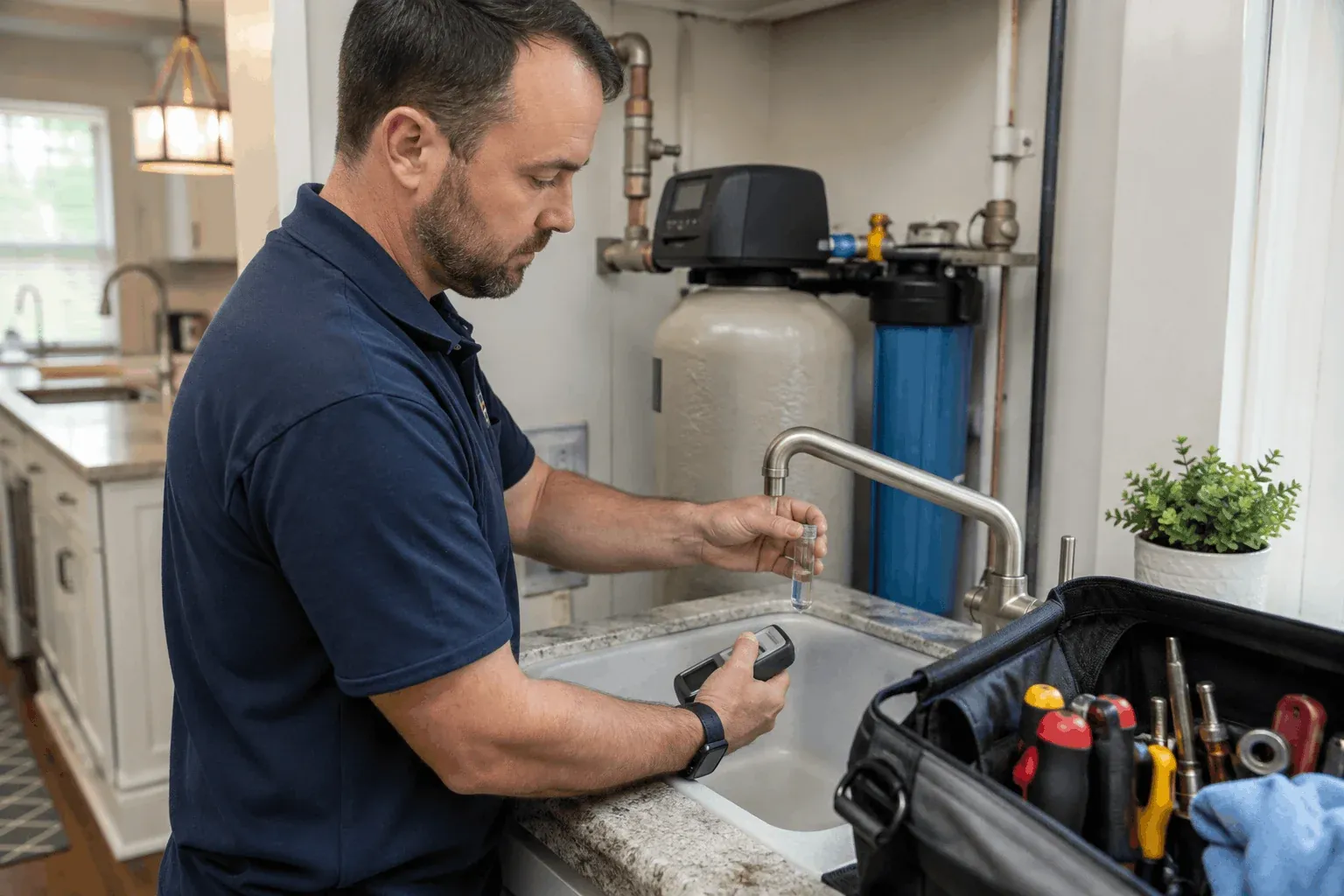
A Consumer Confidence Report describes water leaving a plant or averaged across a distribution system, not water arriving at your address. The free test closes that gap in about twenty minutes.
Asked locally.
Is a water softener worth it in Fort Worth?
Sometimes, and less often than north of the metroplex. Fort Worth reports 6 to 10 grains per gallon, the softest supply of the fourteen cities we serve. At the low end of that range a softener may not earn its place, so we measure at your tap first and will say so if the answer is no.
What water treatment is most useful for a Fort Worth home?
Usually filtration rather than softening. The city treats with chloramine, which ordinary carbon barely touches, so whole house filtration in Fort Worth is built around catalytic media rated for it. That is what changes the shower smell and the taste at every tap.
Does whole house filtration help with the chlorine smell here?
Yes, when the media is right. Chloramine is chlorine bound to ammonia and is far more stable than free chlorine, so it needs catalytic carbon and enough contact time rather than a standard cartridge. Sizing the bed to your peak flow is what makes the difference.
What about iron or manganese in Fort Worth water?
Both are reported in the city supply and both are aesthetic rather than a compliance problem. They show up as staining on fixtures and laundry and as a metallic edge to the taste. Filtration handles them at every fixture, and the media choice follows what your reading actually shows.
Is reverse osmosis worth adding for drinking water?
It is the practical answer if your concern is what you drink rather than what you wash in. Fort Worth pursued a major PFAS action, which keeps drinking water a live question here. An under-sink membrane treats the one tap you drink from and pairs with whatever whole house system you already have.
How long does installation take?
Usually half a day for whole house work, with the water off for two to three hours. Filtration-only installs are often quicker, and a good number of Fort Worth homes need filtration rather than softening, so the job can be shorter than homeowners expect.
Where can I read Fort Worth’s own water report?
The source we work from is published at fortworthtexas.gov. That is the source for the figures on this page.
Get your own Fort Worth reading.
A test gives you hardness, chlorine and dissolved solids readings, and an honest recommendation built on them.