How hard is the water in Colleyville?
Whole house filtration and drinking water systems installed in Colleyville, with softeners sized from a reading. Colleyville reporting lists the PFAS compounds it tests for as not detected. What the data does show is disinfection byproducts and taste, and those are the ones worth treating.
Follows the Tarrant County supply
How hard is Colleyville water?
Taste and disinfection byproducts, more often than hardness. The city publishes no hardness figure, so softening here starts with a reading rather than an assumption. What the reporting does show is byproducts and taste, and those are the ones most homeowners notice.
Colleyville’s water, measure by measure.
Colleyville tests for six PFAS compounds and its reporting lists all six as not detected. That’s a good result and it deserves to be stated rather than buried. It also moves the useful conversation somewhere else. What the reporting does list is disinfection byproducts: bromate, trihalomethanes and haloacetic acids. Those are a taste and drinking water question, and they’re what treatment here should actually be aimed at.

Finished surface water bought in through the Tarrant County supply.
We size to your house rather than a city average.
PFOA, PFOS, PFHxS, PFNA, PFBS and PFHpA all listed as not detected.
Disinfection byproducts, which affect taste.
That follows from the supply chain, not from a Colleyville measurement.
The city’s own water quality report page.
Every number here is published by someone.
These figures come from the city or district that treats the water, and we name the report so you can read it yourself.
What this means for your house in Colleyville.
A Consumer Confidence Report describes water leaving a plant or averaged across a distribution system, not water arriving at your address. The free test closes that gap in about twenty minutes.
Asked locally.
What is worth treating in Colleyville water?
Taste and disinfection byproducts, more often than hardness. The city publishes no hardness figure, so softening here starts with a reading rather than an assumption. What the reporting does show is byproducts and taste, and those are the ones most homeowners notice.
Does Colleyville water contain PFAS?
The city reporting lists the PFAS compounds it tests for as not detected. That is a good result and worth saying plainly. If you still want drinking water treated at the tap, a membrane station handles dissolved solids and taste, but we do not sell it as a PFAS fix where PFAS was not found.
Is reverse osmosis useful for drinking water here?
It is if the complaint is taste at the kitchen tap. A membrane reduces dissolved solids, which neither a softener nor a carbon filter touches, and feeds a dedicated faucet. See reverse osmosis in Colleyville.
Do larger Colleyville homes need bigger systems?
They usually need correctly sized ones, which is not the same as bigger. Peak flow and fixture count decide bed volume and capacity. An undersized bed passes water through faster than the chemistry needs, and that shows up as performance dropping off after the first year.
How long does installation take in Colleyville?
About half a day for whole house work, with the water off for two to three hours. In Colleyville the sizing survey is the longer part, because larger homes draw higher peak flow than a standard bed is built for.
Do you charge for a quote in Colleyville?
No, neither one costs you anything. Colleyville publishes no hardness figure, so softening decisions start from a measurement here, and you get one price for whatever the reading actually supports.
Where can I read Colleyville’s own water report?
The source we work from is published at colleyville.com. That is the source for the figures on this page.
Get your own Colleyville reading.
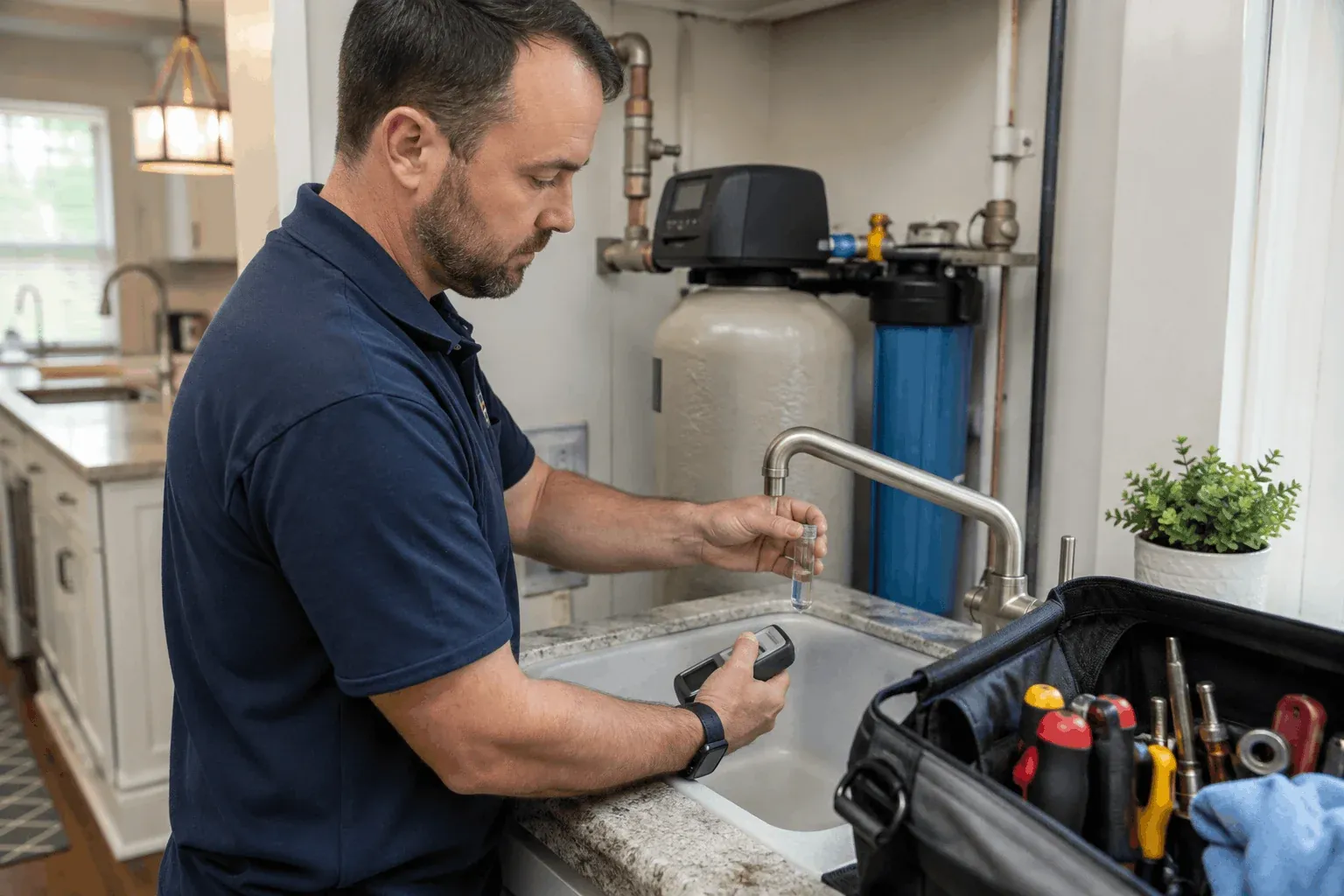
Twenty minutes at your kitchen sink gives you hardness, chlorine and dissolved solids for your own address.