Filter, purifier or reverse osmosis: what the words mean.
Filter, purifier and reverse osmosis are three different things. The standard a product is certified to, and the claims listed under it, say which one you are looking at.
Published October 12, 2026 by Water Treatment Co.
What is the difference between a water filter, a water purifier and reverse osmosis?
A filter is certified to reduce specific things, from chlorine taste to a contaminant with a health effect. A purifier claim is about bacteria, viruses and cysts. Reverse osmosis, in CDC’s words, uses a process that reverses the natural flow of water, and the kind we fit sits under the kitchen sink with its own tap. What any product does is set out in its certification, not its name.
No federal regulations cover home filters, purifiers or reverse osmosis.
NSF International states that no federal regulations exist for residential water treatment filters, purifiers and reverse osmosis systems. What exists instead are voluntary national standards, and independent certification against them.
The standards are numbered, and the numbers are names rather than a ranking. NSF/ANSI 58 is not a better grade than NSF/ANSI 42. It covers a different kind of product.
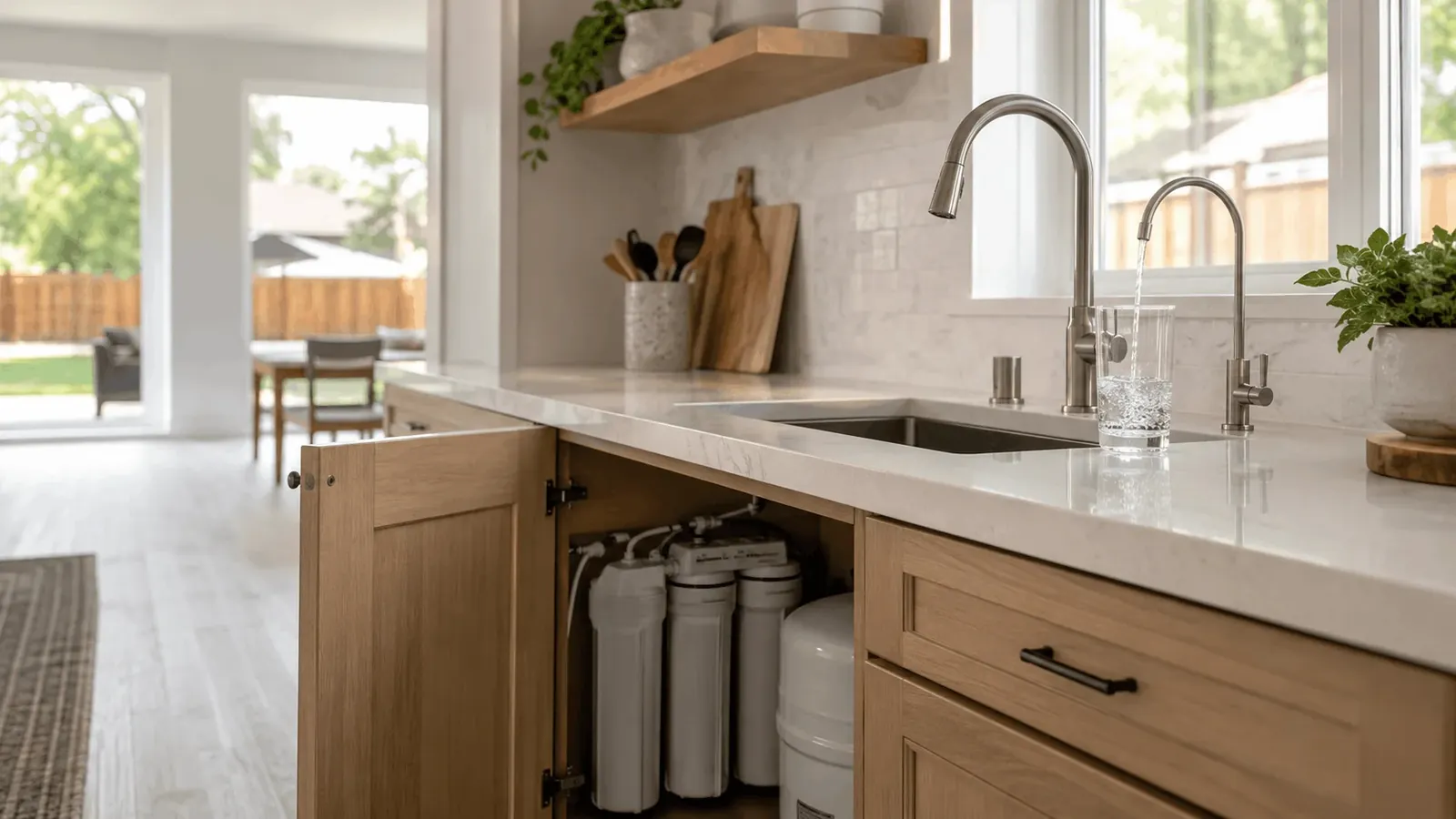
Reverse osmosis is the one we fit for drinking water: our reverse osmosis installation puts the unit under the kitchen sink with its own tap on the counter.
| Standard | What it covers |
|---|---|
| NSF/ANSI 42 | Aesthetic effects. Claims can include chlorine, taste and odor, chloramine, particulate, iron, manganese, zinc and total dissolved solids. |
| NSF/ANSI 53 | Reduction of a contaminant with a health effect, claim by claim. |
| NSF/ANSI 58 | Reverse osmosis systems. |
| NSF/ANSI 401 | Systems verified to reduce one or more of 15 emerging contaminants. |
| NSF/ANSI 55 | Ultraviolet systems. Class A treats bacteria, viruses and cysts. Class B is for water that is already disinfected. |
| NSF/ANSI 44 | Water softeners whose resin is regenerated with sodium or potassium chloride. |
| NSF/ANSI 244 | Filters intended only for public water supplies that are treated or determined to be microbiologically safe. |
| NSF P231 | Microbiological water purifiers, tested against EPA’s 1987 guide standard. |
What “purifier” means as a claim.
As a claim, purifier has a specific meaning. CDC’s guidance for travelers explains that a manufacturer claiming EPA purifier status must show, by its own testing, that the product removes at least 99.9999 percent of bacteria, 99.99 percent of viruses and 99.9 percent of Cryptosporidium or Giardia cysts. CDC also notes that EPA does not independently test those claims.
NSF’s P231 protocol certifies microbiological water purifiers against EPA’s 1987 guide standard, which is how a purifier claim gets checked by a third party. City water in Dallas-Fort Worth is disinfected by the utility before it reaches the house, so a purifier claim is aimed at untreated water, which is where CDC discusses it.
Certification is claim by claim.
NSF is explicit that certification to a standard does not mean a filter, purifier or treatment system will reduce all possible contaminants. A certified listing names the contaminants the product was tested for, and claims under NSF/ANSI 42 and 53 vary from product to product.
CDC makes a related point from the other direction: filters that remove germs often do not remove chemicals, and the reverse is also true.
Reverse osmosis, and what it reduces.
CDC lists lead, copper, chromium, chloride and sodium among the chemicals reverse osmosis removes, notes that it may also reduce arsenic, fluoride, radium, sulfate and nitrate, and advises checking the label for the specific chemicals a system is certified to reduce. CDC describes the process as pushing water from a solution containing more substances through a filter toward cleaner water. Texas A&M AgriLife Extension adds that reverse osmosis is not recommended for sediment.
CDC describes point of use systems as treating water and delivering it to a single tap, such as your kitchen sink. That is how we fit reverse osmosis: it goes in the cabinet under the kitchen sink, with its own tap on the counter, and it treats the water your family drinks and cooks with.
Where reverse osmosis fits with the rest of the house.
Reverse osmosis covers the kitchen tap, not the house. Most homes here take reverse osmosis alongside a softener and whole house filtration: the softener for the minerals and the carbon tank for the chlorine, so the rest of the house is covered too.
A whole house carbon tank fits on the line where water comes into the house, so every faucet and every shower runs through it rather than just the kitchen sink. That is a point of entry system: CDC uses the term for filters that filter water as it comes into your home, and lists under sink filters and those that attach to your faucet as point of use.
Softeners have a standard of their own, NSF/ANSI 44, because hardness is a different job from filtration. None of the filter media takes out calcium or magnesium.
PFAS, and the certification EPA points to.
For PFAS, EPA’s advice is specific: check the product packaging for certification to NSF/ANSI 53 or NSF/ANSI 58 for PFAS reduction. EPA notes that, as of April 2024, those certifications focus on PFOA and PFOS, and that changing filters on the manufacturer’s replacement schedule matters for keeping the reduction going.
What the cities we serve report about PFAS is on our PFAS in DFW water page, and when each reverse osmosis stage needs changing is in our RO filter replacement schedule.
Chloramine, carbon and the label.
The swimming pool smell people notice in DFW tap water is the disinfectant, and across most of our service area it is chloramine. NSF/ANSI 42 claims can include chloramine as well as chlorine, which matters here because ordinary carbon does not take chloramine out.
Our whole house filtration uses catalytic carbon for that reason, and why the smell gets stronger for part of the year is covered on its own page.
Sources
- NSF International, “NSF Standards for Water Treatment Systems” (consumer resources)
- NSF International, “NSF/ANSI 42, 53 and 401: Filtration Systems Standards” (December 16, 2025)
- CDC, “Water Disinfection for Travelers,” CDC Yellow Book 2026 (April 23, 2025)
- CDC, “About Home Water Treatment Systems” (April 10, 2024)
- CDC, “About Choosing Home Water Filters” (April 10, 2024)
- US EPA, “Reducing PFAS in Your Drinking Water with a Home Filter” (last updated August 3, 2026)
- US EPA, “Identifying Drinking Water Filters Certified to Reduce PFAS” (last updated November 18, 2025)
- Texas A&M AgriLife Extension, Texas Well Owner Network, “Well Owner’s Guide to Water Supply” (SCSC-PU-154, May 2023)
Answered before you ask.
Is a water purifier better than a water filter?
Not as a rule. A purifier claim is about bacteria, viruses and cysts. A filter is certified for whatever its listing names, from chlorine taste and odor to a contaminant with a health effect.
Does NSF/ANSI 58 mean a system removes PFAS?
Only if its listing includes a PFAS reduction claim. EPA’s advice is to look on the packaging for NSF/ANSI 53 or 58 certification for PFAS reduction, and EPA notes that as of April 2024 those certifications focus on PFOA and PFOS.
What does NSF/ANSI 53 cover?
NSF describes NSF/ANSI 53 filters as certified to reduce a contaminant with a health effect. Claims under it vary from product to product, and the listing names them.
What does NSF/ANSI 401 cover?
NSF describes it as covering systems verified to reduce one or more of 15 emerging contaminants. As with the other standards, the listing names which of those a product was tested for.
What is the difference between NSF/ANSI 55 Class A and Class B?
NSF describes Class A ultraviolet systems as inactivating bacteria, viruses and cysts. Class B systems are for reducing non disease causing bacteria in water that has already been disinfected.
Does a whole house filter soften water?
No. Filter media does not take out calcium or magnesium, which is why softeners have their own standard, NSF/ANSI 44, and why the two systems are commonly installed together.
Want treated water at the kitchen sink?
Tell us what you want out of your drinking water and we will quote a system for the tap you drink from.