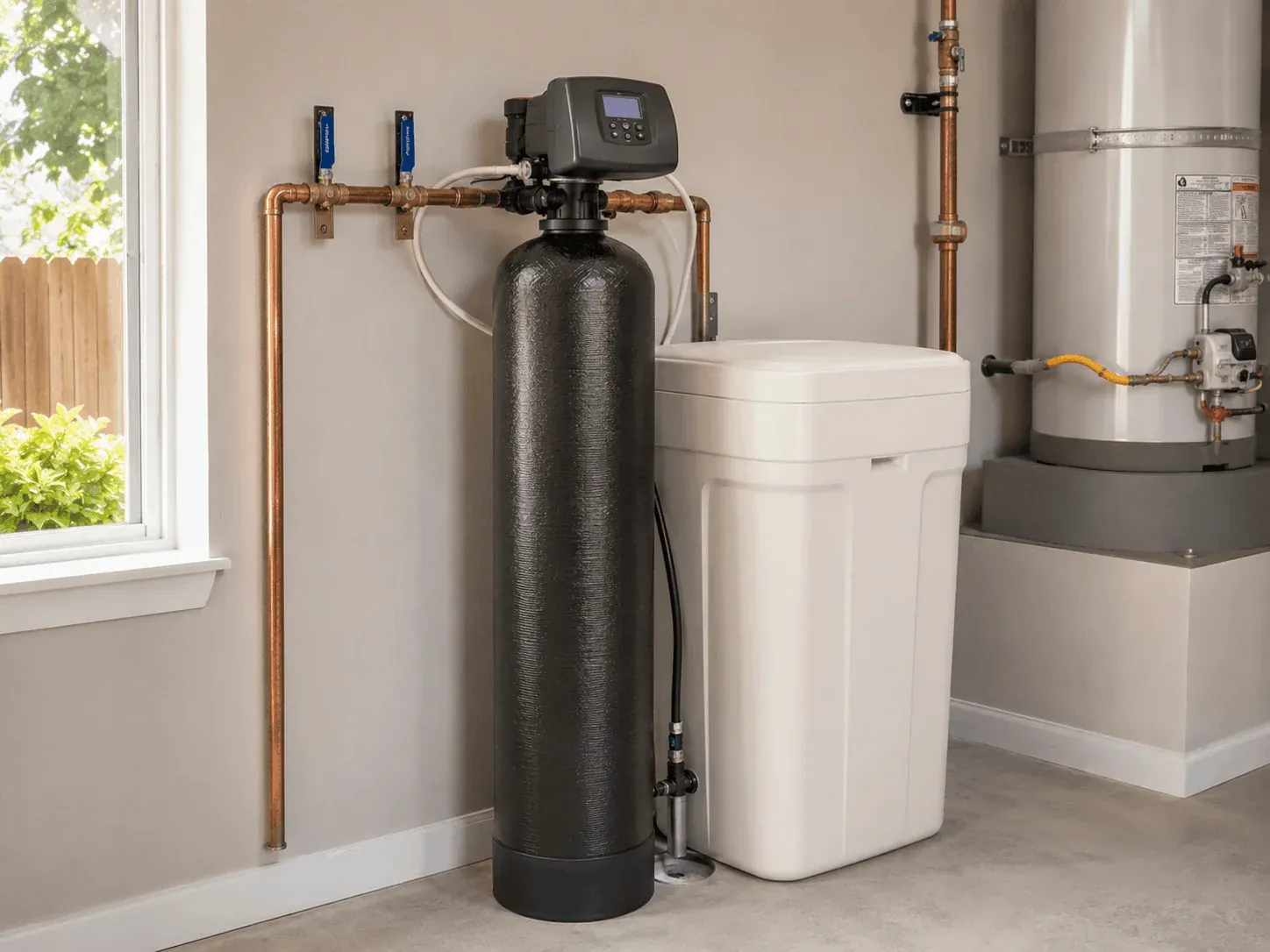
Replacing an old water softener: what decides it.
A lot of the softeners we put in are replacing units that have given up. Three things decide whether yours is due: the resin, the valve and the house.
Published October 12, 2026 by Water Treatment Co.
What decides when a water softener should be replaced?
Three things: how worn the resin is, whether the control valve regenerates on a timer rather than on the water you use, and whether the unit is still sized for the household and the hardness of your water.
The resin bed.
The resin is the part that does the softening, and it does wear. Purolite, a resin manufacturer, says a premium softening resin can give reliable operation for over ten years in a well designed system. It also gives a rule of thumb for what shortens that: for each 1 mg/L of chlorine in the incoming water, resin life is reduced by half, and each further 1 mg/L halves it again. Iron in the water speeds the damage up.
ResinTech, another resin manufacturer, says that whenever chlorine is above 0.5 parts per million, steps should be taken to protect the resin, either a carbon prefilter ahead of the softener or a more heavily crosslinked resin, which it says can sometimes double resin life.
Across most of our service area the disinfectant is chloramine rather than free chlorine, and both manufacturers’ figures are given for chlorine.
When an old unit is replaced, the new one goes in under our water softener installation: sized to your water, installed in one visit, with a lifetime manufacturer warranty on the softener.
How the valve decides when to regenerate.
Some softeners regenerate on a timer. The Minnesota Pollution Control Agency describes timer models as running at set intervals regardless of whether the resin needs it, and recommends replacing them with demand based units. It reports that in Marshall, Minnesota, residents who replaced or optimized their water softeners reduced the amount of salt they used every year by 86 percent.
The Water Quality Association’s best practice guidance says to avoid time clocks for starting regeneration and to use demand initiated regeneration instead, and EPA’s WaterSense guide gives buyers the same direction: a model with demand initiated regeneration, lower water use and higher salt efficiency.
What NSF/ANSI 44 certifies.
NSF/ANSI 44 is the standard for residential water softeners, the kind that use a cation exchange resin regenerated with sodium or potassium chloride. EPA’s WaterSense guide notes that it includes a voluntary efficiency rating of 5.0 gallons of water or less per 1,000 grains of hardness removed: the water a softener uses for the hardness it takes out.
Texas homes on a septic system.
If the unit drains to a septic system, Texas has a rule of its own. A softener discharging to an on site sewage system must conserve water by design, regenerate using a demand initiated regeneration device, and be clearly labeled as having one.
A unit installed before September 1, 2003 can stay in use without that device, but when it is replaced, the replacement has to meet the rule.
Whether it still fits the house.
A softener is sized to the hardness of the water and to how much water the household goes through. The Minnesota Department of Health advises making sure a softener is set to the hardness of your water supply. The Water Quality Association warns against oversizing equipment and overtreating water as wasteful practices.
More people in the house, a move, or a change of supply all move those numbers. Our water softener sizing guide shows the method, and each city’s hardness is on our DFW water quality pages. What moves the price of a new unit is in our water softener cost guide.
Across the fourteen cities we serve, figures range from about 5 grains per gallon in Mansfield to about 11.8 in the NTMWD supplied cities, so a unit sized in one city may not suit the next.
What happens when the softener is replaced.
The new unit goes in on the main line, which in most homes is on the garage wall, with the drain run and a bypass valve fitted, and it is installed in one visit. One day in most homes, start to finish, and we schedule it for a day that suits you.
The new softener is sized to your water and your household, with its brine tank beside it. Together they take up about the space of a water heater. We show you what is now in the house, what it is doing and the two or three things worth knowing about living with it.
Everything is configured for your water and run on site. Nothing is left on factory settings. It carries a lifetime manufacturer warranty for as long as it is yours, and labor carries a one year warranty from the day it goes in. After the first year, a service visit is $80.
Sources
- Purolite (Ecolab), “Factors That Effect Softening Resin Performance and Life”
- ResinTech, Technical Data Sheet “Chlorine Oxidation” (REV 0421)
- Minnesota Pollution Control Agency, “Eco Living: Use less salt in your water softener to cut pollution and save money” (November 22, 2024)
- Minnesota Department of Health, “Home Water Softening Frequently Asked Questions” (last updated October 3, 2022)
- Water Quality Association, “Getting Smart with Softeners: Best Practices for Industry Professionals and Tips for Consumers”
- US EPA WaterSense, “WaterSense Guide to Selecting Water Treatment Systems” (832-F-24-024, November 2024)
- NSF International, “NSF Standards for Water Treatment Systems” (NSF/ANSI 44)
- Texas Health and Safety Code section 366.013 (S.B. 1633, 78th Legislature, 2003), and TCEQ, “On-Site Sewage Facility Rules Compilation” (RG-472)
Answered before you ask.
How long does water softener resin last?
Purolite says a premium softening resin can give reliable operation for over ten years in a well designed system. Chlorine and iron shorten that. By Purolite’s rule of thumb, each 1 mg/L of chlorine in the incoming water halves resin life.
Is a timer softener worth replacing?
The Minnesota Pollution Control Agency says yes: it recommends replacing timer units with demand based ones, because timer models regenerate at set intervals whether the resin needs it or not. The Water Quality Association also recommends demand initiated regeneration.
Should the new softener be the same size as the old one?
Not necessarily. The new unit is sized to the water and the household as they are now, which may not be what the old one was sized for. Our water softener sizing guide sets out the method.
Does a replacement softener in Texas have to be demand initiated?
If it discharges to a septic system, yes. Texas law calls for a demand initiated regeneration device and a label saying so, and a softener installed before September 1, 2003 has to be replaced with one that meets the rule when it is replaced.
Does a new softener need to be set to my water?
Yes. The Minnesota Department of Health advises setting a softener to the hardness of your water supply. On our installs, everything is configured for your water and run on site, and nothing is left on factory settings.
How long does a replacement take?
One day in most homes, start to finish. The new unit goes in on the main line and it is installed in one visit.
Can you install without an existing softener loop?
Yes. Plenty of houses here were never plumbed with one. We tie into the main line where water comes into the house and run what is needed. We confirm it on the visit, before you commit to anything.
What access do you need on installation day?
A clear path to the main water line, which in most homes is on the garage wall, and to a drain. Someone should be home so we can walk you through it at the end.
Can you replace my existing water softener?
Yes. Tell us what is in there now and roughly how old it is when you call, and we will tell you what we can do with it. A lot of the softeners we put in are replacing units that have given up.
Replacing an older softener?
Tell us what is in there now and roughly how old it is, and we will quote the replacement.