What size water softener do I need?
Capacity is arithmetic, not opinion. Household size times daily use times your measured hardness, targeted at a sensible regeneration interval, rounded up to the next standard tier.
How do I calculate what size water softener I need?
Multiply the number of people in the house by about 75 gallons of daily use, multiply that by your hardness in grains per gallon to get daily grains, then multiply by your target days between regenerations. Round up to the next standard resin capacity. Most households target roughly eight days.
The method, step by step.
Start with daily water use. Around 75 gallons per person per day is the working figure for a typical household. Multiply by the number of people to get daily gallons.
Multiply daily gallons by your hardness in grains per gallon. That gives daily grains, the amount of hardness the resin bed has to remove every day. Multiply that by your target regeneration interval, commonly around eight days, and round up to the next standard resin capacity: 24,000, 32,000, 40,000, 48,000, 64,000, 80,000 or 96,000 grains.
Why the hardness input is where this goes wrong.
Every step above is arithmetic. The only judgment call is the hardness figure you put in, and that is exactly where the market’s regional numbers cause real financial harm.
The North Texas Municipal Water District, which treats the water for Plano, Frisco and Allen, reports up to 202 mg/L, about 11.8 grains by its own conversion. Run the same household through the calculator at 20 grains and at 11.8 and you will see the resin tier jump. That difference is paid up front, and again in salt for as long as you own the system, so the input figure is worth measuring rather than assuming.
Two adjustments worth making
Sized for your home and your water.
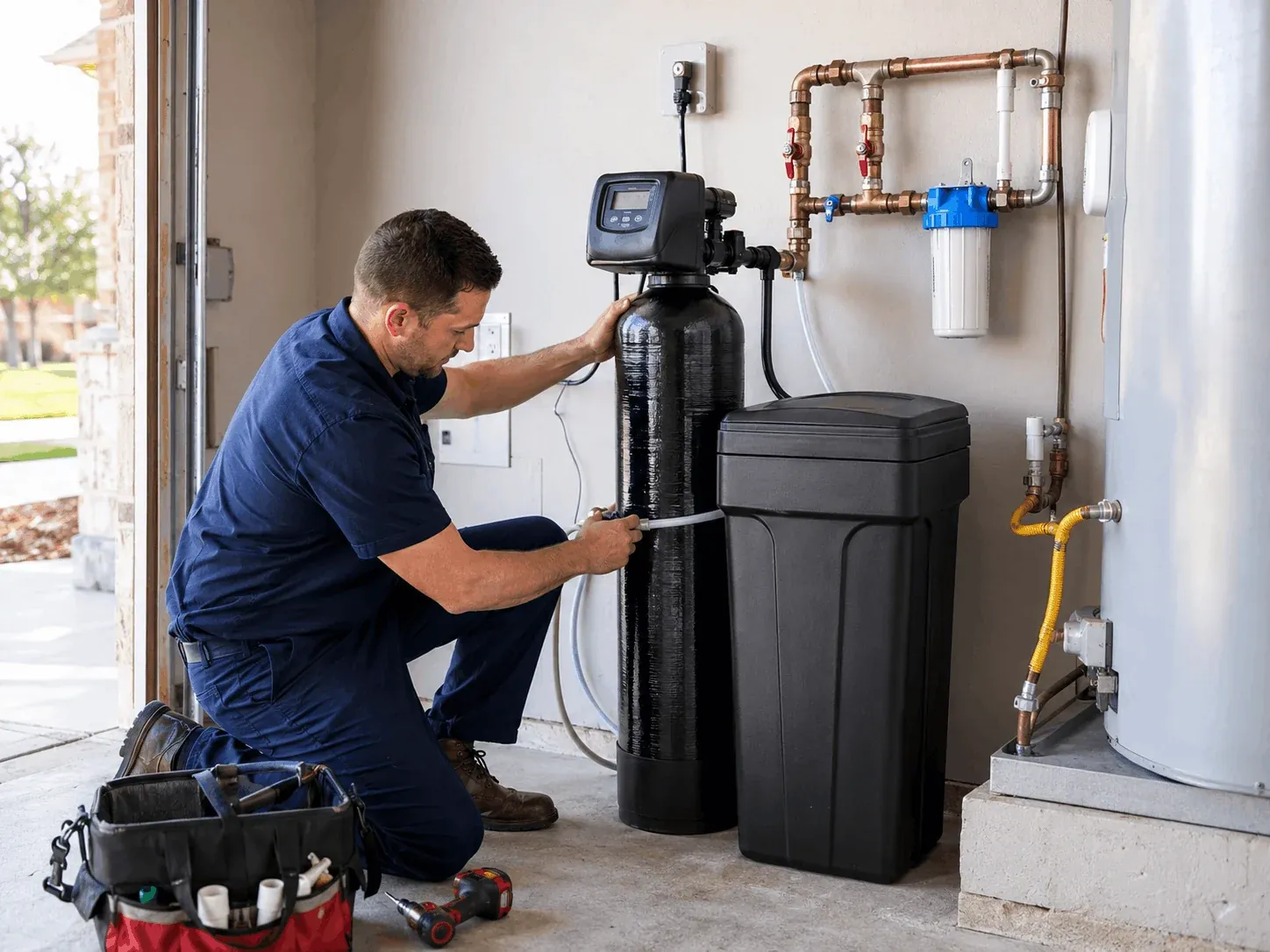
Capacity is arithmetic, not a sales tier. Household size and your measured grains per gallon decide how much resin the system needs and how often it regenerates. Size it too small and you run out of soft water; size it too large and you pay for salt you do not need. The figure comes first, the equipment second.
- Sized to your measured water
- Set for efficient regeneration
- Installed for your home’s plumbing
Answered before you ask.
Is a bigger softener always better?
No. An oversized unit costs more up front and can sit too long between regenerations, which is not good for the resin bed. The aim is the smallest capacity that comfortably covers your household at a sensible interval, which is what the calculation above produces.
How often should a softener regenerate?
Around every seven to twelve days is typical for a correctly sized system on a metered valve. Regenerating every two or three days usually means the unit is undersized for the water; going three weeks or more often means it was sized on a hardness figure well above the real one.
Can I use my city’s published hardness figure?
As a starting point, yes. But four of the fourteen cities publish no figure at all, and Grand Prairie genuinely varies by neighborhood and by season. A measurement at your tap is what the sizing should actually use.
Get the hardness figure this calculation needs.
We size to your house rather than to a regional average. Tell us how many people live there and we will quote it.