Treating well water around DFW, and how it differs from city water.
A city treats its water and publishes a report on it. A private well does neither, so the system that treats it is built around that well.
Published October 12, 2026 by Water Treatment Co.
How is well water treatment different from city water treatment?
A city treats its water before it reaches your house and reports on it. A private well does neither. In Texas the owner is responsible for maintaining the well and testing the water, groundwater in this part of the state changes with depth, and a well takes more equipment than a city supply.
Who looks after a private well in Texas.
The owner. EPA explains that private wells are not regulated under the federal Safe Drinking Water Act, nor by most state governments, and that private well owners are responsible for delivering safe drinking water to their households. TCEQ says the same for Texas: it does not regulate private drinking water wells, and the owner is responsible for maintaining the well and testing the water.
That is the main difference from city water. The cities we serve publish water quality reports, and our DFW water quality pages are built from them. None of those reports describes a private well.
Homes on well water are part of what our water treatment installation covers. Well water takes more equipment than city water, and the price runs above our city water range.
What a yearly well test covers.
EPA advises testing a private well every year, and its yearly list includes total dissolved solids and pH. CDC gives the same yearly advice and says to use a state certified laboratory. Texas A&M AgriLife Extension also recommends a new test after the pump or the well has been serviced, and whenever the water changes color, taste or smell.
Why groundwater in North Texas varies so much.
The Texas Water Development Board’s descriptions of the Trinity and Woodbine aquifers show how much groundwater in this part of the state changes with depth. In the Trinity Aquifer, the board describes the water as fresh but very hard where the aquifer reaches the surface, with total dissolved solids rising with depth from under 1,000 mg/L to between 1,000 and 5,000 mg/L.
In the Woodbine Aquifer, the board reports fresh water, under 1,000 mg/L of dissolved solids, down to about 1,500 feet, and 1,000 to 4,000 mg/L deeper.
Because the water changes with depth, a city water quality report does not describe it. A city report covers the city’s treated supply, not the groundwater under your house.
Reading the numbers against city water.
Dissolved solids are reported in mg/L or in parts per million, and for water the two are the same measure: Purolite, a resin manufacturer, writes 1 mg/L as 1 ppm. So a well report and a city report can be compared directly.
On city water, Melissa’s dissolved solids are reported at 455 ppm, the highest across our fourteen cities. Deeper Trinity water, at 1,000 to 5,000 mg/L, runs roughly two to eleven times that figure.
Drinking water at the kitchen sink.
For the water your family drinks and cooks with, reverse osmosis goes in the cabinet under the kitchen sink with its own tap. It works alongside a softener and whole house filtration so the rest of the house is covered too. CDC describes point of use systems as treating water and delivering it to a single tap, such as your kitchen sink. CDC lists lead, copper, chromium, chloride and sodium among the chemicals reverse osmosis removes, and advises checking the label for the specific chemicals a system is certified to reduce. Texas A&M AgriLife Extension notes that reverse osmosis is not recommended for sediment, which is one reason the order of the equipment matters on a well.
What goes into a well system.
Texas A&M AgriLife Extension’s well owner guide says the equipment that removes larger particles such as sand and grit belongs ahead of the equipment that treats smaller constituents. The same guide describes the pressure tank as holding water in reserve, so that small demands do not keep starting the pump.
Where well water is very hard, a whole house water softener is the piece that deals with it: it takes the calcium and magnesium out on the main line.
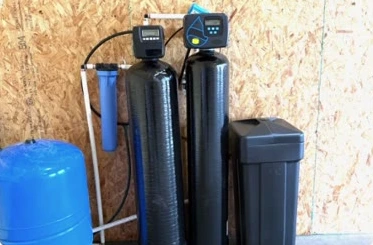
The well system in our own completed work includes a sediment prefilter, two treatment tanks, the brine tank and the pressure tank, all on one wall.
Treatment follows what is in the water.
Texas A&M AgriLife Extension’s guide to solving household water problems makes the point directly: once you have found out all you can about your water, you can select the appropriate treatment method. Water that has no problems and nothing above acceptable limits does not need treating at all.
We check your water, the plumbing and where a tank can sit, and that is what our recommendation is built on.
What the installation covers.
The whole house tanks tie into the line where water enters, usually on the garage wall, with the drain run and a bypass valve fitted. Everything is configured for your water and run on site. Nothing is left on factory settings. At the end we walk the house with you, point out each piece and explain what it does.
What a well system costs, compared with city water.
Most homes here take reverse osmosis alongside a softener and whole house filtration. On city water, a water softener, whole house filtration and reverse osmosis drinking water, installed together, run $2,495 to $5,500. Well water runs above it, because a well takes more equipment.
Where you land in that range comes down to how many of the three you take, how the house is plumbed, where the equipment has to go and how much water the household uses. You get your quote in writing, before anything is ordered, and financing is available.
Sources
- US EPA, “Private Drinking Water Wells” (last updated August 25, 2026)
- US EPA, “Protect Your Home’s Water” (last updated February 26, 2026)
- CDC, “Guidelines for Testing Well Water” (July 1, 2024)
- CDC, “About Home Water Treatment Systems” (April 10, 2024)
- TCEQ, “Groundwater Contamination Notification: What You Need to Know” (last modified February 3, 2026)
- Texas A&M AgriLife Extension, Texas Well Owner Network, “Water Well Basics” (SCSC-PU-137, May 2023)
- Texas A&M AgriLife Extension, Texas Well Owner Network, “Well Owner’s Guide to Water Supply” (SCSC-PU-154, May 2023)
- Texas A&M AgriLife Extension, “Solving Water Quality Problems in the Home” (ESC-051)
- Texas Water Development Board, “Trinity Aquifer” and “Woodbine Aquifer” aquifer pages
- Purolite (Ecolab), “Factors That Effect Softening Resin Performance and Life” (mg/L and ppm)
Answered before you ask.
Does TCEQ test private wells?
No. TCEQ states that it does not regulate private drinking water wells, and that the owner is responsible for maintaining the well and testing the water.
How often does EPA say to test a private well?
Every year. EPA’s yearly list includes total dissolved solids and pH, and CDC gives the same yearly advice and says to use a state certified laboratory.
Can I plan well water treatment from a city water quality report?
No. A city report describes the city’s treated supply. A private well draws its own groundwater, and in the Trinity and Woodbine aquifers that water changes with depth, so the figures that matter come from your own well.
What is the pressure tank for?
Texas A&M AgriLife Extension describes the pressure tank as holding water in reserve, so that small demands do not keep starting the pump.
What access is needed before installation?
A clear path to the main water line, usually on the garage wall, and to a drain. For reverse osmosis we need the cabinet under the kitchen sink clear.
Do you install treatment for homes on well water?
Yes. Well water takes more equipment than city water, and the price runs above our city water range. Call and tell us about the house and the well.
On a private well?
Call and tell us about the house and the well, and we will quote the system it needs.