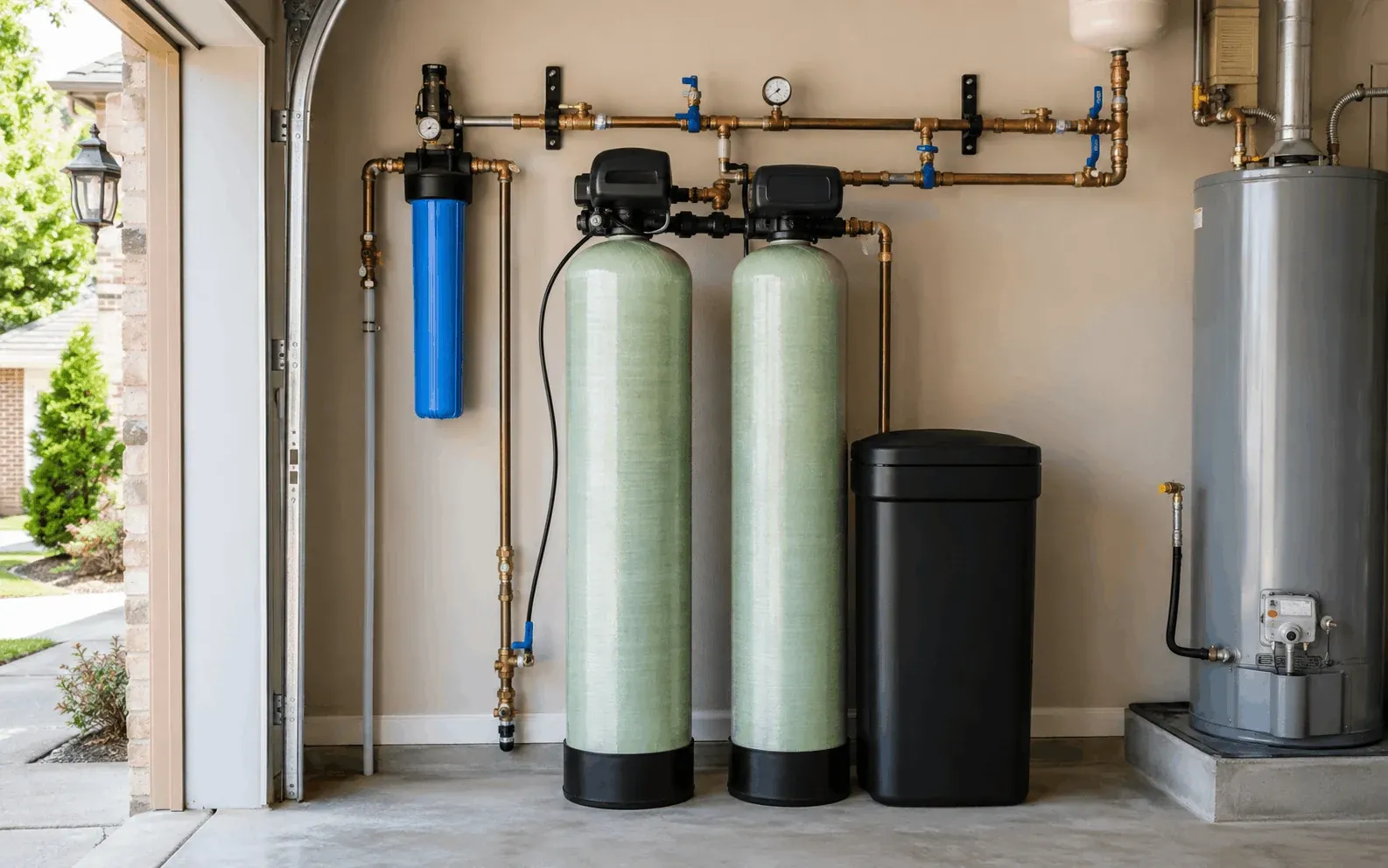
Filtration media, and why the wrong one disappoints.
Most whole house filtration complaints in this market trace to one decision: the media specified was rated for chlorine, and the supply is chloramine.
What is the difference between carbon and catalytic carbon?
Standard granular activated carbon adsorbs free chlorine effectively but reacts too slowly with chloramine at household flow rates. Catalytic carbon has a surface modified to accelerate that reaction, so it handles chloramine within the contact time a domestic system provides.
| Media | Target | Where it fits in DFW |
|---|---|---|
| Sediment | Particulate, grit, turbidity | Always first. Protects everything downstream from blinding. |
| Granular activated carbon | Free chlorine, taste, odor | Adequate in Dallas, which runs free chlorine rather than chloramine. |
| Catalytic carbon | Chloramine, plus everything GAC does | The correct specification across most of our service area. |
| KDF media | Chlorine, some metals, bacteriostatic | Used in combination beds; not a substitute for correct carbon sizing. |
| RO membrane | Dissolved solids, PFAS, lead | Point of use only. A different job from whole house filtration. |
If you would rather not work through this yourself, this is what our whole house water filtration covers, and most of it is a single visit.
Contact time is half the specification.
Media choice is only half of it. The other half is bed volume, sized to your peak flow rate. Water has to spend long enough in contact with the media for the chemistry to happen. Push it through faster than that and even the correct media underperforms.
This is why pressure complaints after a filtration install are almost always a sizing error rather than a property of filtration itself: an undersized bed, or a sediment pre-filter that has blinded and is now the restriction.
Which media your city calls for.
Dallas runs free chlorine, with a residual reported averaging 2.97 ppm, so standard carbon performs well there. Most of the rest of our service area is chloramine: the NTMWD cities, Fort Worth and everything on Fort Worth supply, Grapevine on its own system, and Melissa.
Mansfield is its own case. The city treats with granular activated carbon at its own plant and acknowledges seasonal algae-driven taste and odor events that exceed what that media can handle, so filtration at the house there is answering a specific, documented, recurring event.
Backwash, and why year two matters.
A bed that never backwashes will channel: water finds a path of least resistance through the media and stops contacting most of it. Performance drops quietly, without any obvious failure. A backwash control valve is what prevents that, and it is the difference between a system that still works in year three and one that stopped in year two without telling you.
Answered before you ask.
Will standard carbon remove chloramine at all?
Partially and slowly. The reaction needs more contact time than a domestic system at normal flow rates provides, which is why the complaint usually persists after installing one. Catalytic carbon is specified precisely to close that gap. NSF/ANSI 42 claims can include chloramine as well as chlorine, and what filter labels mean covers how to read them.
How do I know which disinfectant my city uses?
Your city page carries it, cited to the municipal or district report. Dallas runs free chlorine; most of the rest of our service area runs chloramine. It changes the media specification, so it is worth checking before buying anything.
Does filtration remove hardness?
No. None of these media remove calcium or magnesium, so scale keeps forming regardless of how good the filtration is. Hardness is a softener’s job, which is why the two systems are commonly installed together in the harder cities.
Get the reading that sets the specification.
A free chlorine reading at your own fixture tells you whether standard or catalytic media is the honest answer for your home.